
Why Korean Surgeons Lead Global Cosmetic Innovation
Read about Why Korean Surgeons Lead Global Cosmetic Innovation on faceon

Forget everything you think you know about plastic surgery. The numbers don't lie: almost a quarter of every aesthetic procedure performed globally—every nip-tuck, face tweak, and body sculpt—originates from South Korea. But this isn't merely a matter of volume. They aren’t just mass-producing procedures; they are actively inventing the future of the entire aesthetic industry. While other nations play catch-up, deciphering what Korean practitioners pioneered six months prior, the pressing question remains: What transforms South Korea into such a powerful epicenter for cutting-edge aesthetics? It's a perfect storm—a potent blend of unique cultural drivers, substantial economic investment, and an unyielding pursuit of perfection. This hyper-competitive ecosystem relentlessly pushes boundaries, forcing constant refinement across every facet of the practice. It's not just about exceptional surgeons; it's about an entire system meticulously engineered for innovation.
South Korea isn't just a global leader in plastic surgery; it's the undisputed forge of its future, driven by a unique confluence of culture, capital, and a relentless pursuit of perfection.
Brief and TL;DR
South Korea's dominance in cosmetic surgery transcends mere scale; it's a comprehensive industry powerhouse, not a niche market. However, it's also a complex landscape fraught with potential pitfalls for the uninformed. This market was already colossal in 2020, valued at a staggering $10.7 billion, performing nearly a quarter of all global cosmetic surgeries and boasting the highest per-capita rate worldwide. The burning question is how they achieved this, and the answer extends far beyond just skilled practitioners.
It's a unique confluence of deep-seated cultural norms, severe economic pressures, and a level of competition so fierce it compels constant innovation: faster, better, and often more cost-effective procedures. Their aesthetic philosophy is distinct: enhancing natural beauty without drastic transformation, striving for 'natural harmony' through subtle refinements. This approach fuels the demand for specialized procedures, from advanced facial contouring like the coveted 'V-line' to nuanced eye surgeries and innovative non-invasive treatments. The intense competition among clinics simultaneously drives down costs and elevates quality for the local market. For international patients, however, vigilance is paramount. Post-procedure care and legal recourse, once you've departed, become your sole responsibility, often with minimal avenues for redress.
South Korea commands the cosmetic surgery world because it’s a perfect storm of ancient beliefs, crushing economic pressure, and brutal medical competition that relentlessly propels innovation forward.
The Cultural and Economic Bedrock of a Beauty Powerhouse
It’s easy to dismiss the Korean beauty phenomenon as mere vanity—people chasing a superficial trend, simply just looking pretty. But you’d be missing the profound narrative. The roots of this obsession run deep, far deeper than contemporary fads. Centuries ago, the practice of gwansang, or facial physiognomy, was commonplace. Your face wasn't just an identity; it was a predictor of your fortune, your destiny. A 'unlucky' nose or 'ill-fated' eyes were not just aesthetic flaws but practical problems that warranted correction—not today, but then. Altering one's appearance was therefore not just tolerated, but often seen as a pragmatic step towards a better life. This isn't a modern invention; it's a deeply wired cultural impulse.
Then came the seismic shock of the 1997 Asian Financial Crisis, which shattered the economic landscape. Companies collapsed, jobs vanished, and unemployment soared from 2.61% to a crippling 6.8%. In this brutal fight for survival, studies revealed that a staggering 80% of recruiters openly admitted to screening candidates based on appearance. Looking good became a necessity, not a choice—a matter of economic survival. This desperate environment fueled the rise of 'Chwieop Seonghyeong,' or employment surgery, where procedures became a painful, expensive investment in one's career. In fact, 20% of these surgeries were reportedly initiated by parents for their children, highlighting the immense societal pressure.
The global explosion of K-pop, K-dramas, and the wider Hallyu wave merely amplified these deeply entrenched beauty standards, exporting them worldwide. People abroad eagerly adopted 'the look,' drawing international patients to Korea. But the true driver isn't just the allure of pop stars; it’s a profound societal bedrock.
The demand for cosmetic surgery in Korea isn’t a fleeting modern trend; it's profoundly rooted in ancient beliefs and forged by periods of intense economic adversity, making it an ingrained aspect of survival.
A Philosophy of Refined Aesthetics

What truly defines the 'secret sauce'? Why does the world crave the Korean aesthetic? The fundamental distinction lies in their approach: they don't aim to transform you into someone entirely different. While other regions are known for 'overdone' or obviously 'botched' results, such outcomes are typically eschewed here. Their philosophy centers on balance and harmony, striving to unveil the best possible version of you—enhancing existing features rather than replacing them. Subtlety is key, a principle that deeply resonates because no one desires to look like a caricature.
Furthermore, the pervasive myth that patients seek surgery in Korea solely to 'look Caucasian' is entirely unfounded and betrays a fundamental misunderstanding of the industry. Procedures like the highly popular V-line jaw reduction, which meticulously refines the jawline, bear absolutely no relation to Caucasian features. Instead, they aim to create a softer, more delicate, and balanced appearance aligned with their unique aesthetic ideals.
Korean surgeons operate not just as technicians, but as artists, skillfully working with existing bone structure and facial contours. Their mastery is evident in the natural yet refined beauty showcased by K-drama stars and K-pop idols—flawless complexions and defined features, yet never appearing artificial or cartoonish. They pursue a distinct form of natural beauty: a meticulously refined natural.
Dispelling common misconceptions, Korean surgeons are unparalleled masters in elevating your inherent features into a refined, enhanced version of yourself, which is the true cornerstone of their global appeal.
Forging the Future: Breakthrough Surgical Techniques
When it comes to innovation, look past the pristine labs and turn your attention to South Korea. They aren't merely performing surgeries; they are actively inventing them. While your local practitioner might be considered 'cutting-edge,' Korean surgeons have perfected procedures you won't even find documented in most standard textbooks. This relentless push of the envelope isn't optional; it's born from an intensely competitive environment that mandates the development of superior, often groundbreaking, techniques.

This drive goes beyond general improvements, extending to highly specialized solutions tailored to specific, culturally defined beauty standards. Consequently, Korean surgeons achieve an unparalleled level of specialization and mastery. We're talking about genuine breakthroughs, not just minor adjustments:
- V-Line Surgery. Far beyond simple bone shaving, this procedure involves the precise recontouring of the mandible (jawbone) for a distinctly slimmer facial profile. The delicate precision involved is consistently executed with exceptional results, as detailed by the Harvard Medical Student Review (2024).
- Minimally Invasive Zygoma Reduction. This complex procedure narrows the face through a single, astonishingly small five-millimeter incision, showcasing an incredible level of surgical finesse.
- Se-AIT (Septoaponeurosis Junctional Thickening). This is a sophisticated evolution beyond traditional double-eyelid surgery, creating a dynamic, natural-looking crease that moves organically with the eye, a far more challenging and aesthetically superior outcome than conventional methods.
- Aegyo Sal. Also known as 'eye smiles,' this uniquely Korean aesthetic involves delicate fat grafting beneath the lower eyelid to create a youthful, subtly puffy look. It's a highly specific, culturally valued procedure that Korean practitioners have perfected, as widely noted by multiple sources for its distinctive approach.
Korean surgeons don't just execute procedures; they redefine them, constantly experimenting and excelling at the most challenging techniques. Because the market relentlessly demands it, pushing them to innovate and refine, South Korea's aesthetic practitioners have rightfully become the global leaders.
The Hyper-Competitive Ecosystem Fueling Innovation
The fundamental reason South Korean plastic surgery leads the world is brutally simple: they have no alternative. What exists there isn't merely a market; it's an intense battlefield. Every doctor, every clinic, is locked in a relentless struggle for every single patient, and this constant friction fuels unparalleled innovation.
Consider the striking statistics: in the US, less than 0.7% of physicians are board-certified plastic surgeons. In South Korea, that figure skyrockets to a staggering 2.6% of all doctors. Imagine that density—so many practitioners vying for the same clientele, as highlighted by the Harvard Medical Student Review (2024).
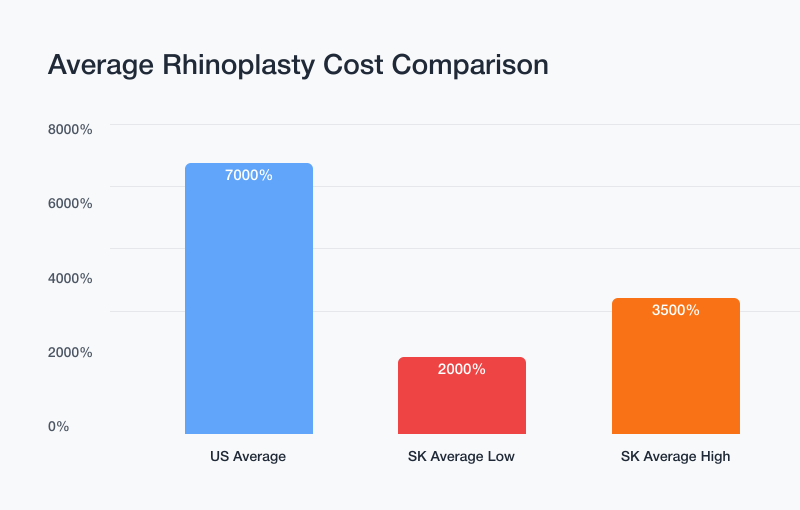
This phenomenon is most concentrated in Seoul’s Gangnam district, particularly the infamous 'Beauty Belt,' where between 400 and 500 cosmetic surgery clinics are packed into a single square mile, competing fiercely, day in and day out. The inevitable outcome? A drastic plummet in prices. While a rhinoplasty might cost upwards of seven thousand dollars in many Western countries, the same or a superior procedure in South Korea can range from two to three and a half thousand dollars.
With price parity, differentiation shifts to quality and technological advancement. Clinics are compelled to adopt the latest technologies instantly. 3D imaging for pre-operative visualization isn't a premium add-on; it's a standard expectation because failure to provide it means losing patients to the competitor next door. The sheer volume of procedures performed daily also provides surgeons with immense practical experience, leading to extreme specialization. They encounter every conceivable case, master intricate techniques, and continuously learn and adapt to meet high demand. This is further intensified by the 'ppalli-ppalli' (hurry-hurry) cultural mindset, often discussed on platforms like Reddit, which prioritizes speed and efficiency without compromising quality.
Ultimately, this isn't just about individual excellence; it's the product of a brutal, hyper-competitive grind that forces practitioners to achieve unparalleled mastery or face obsolescence.
Navigating the Global Hub: A Guide for Medical Tourists
Considering South Korea for your cosmetic surgery needs? While it offers appealing price points and access to some of the world's most specialized practitioners, complete with comprehensive packages—interpreters, post-op care, and more, as noted by BeautyHopper (2024)—it's crucial to understand the complexities. Clinics aggressively court international patients, who can comprise 40-50% of their clientele.
However, the glittering promise can quickly turn into a treacherous minefield. Substandard outcomes are a grim reality, and as an international patient, your avenues for legal recourse are severely limited, a fact clinics exploit. Foreign embassies, including the Chinese embassy, have issued explicit warnings regarding patient safety, even reporting fatalities from repeated procedures—a stark testament to the seriousness of the risks.
Moreover, unethical practices are not uncommon. A documented tactic involves clinics refusing to release patient medical records, as seen in cases like Opera PS mentioned on Reddit. Without these records, you are effectively trapped, unable to file formal disputes or seek further treatment, leaving your word against theirs in a desperate situation. Be wary of online reviews; many are paid promotions, and clinics are known to wield strict defamation laws to silence negative feedback, suing patients who dare to speak out.
Therefore, extreme caution and thorough due diligence are non-negotiable. For those seeking guidance, services like Face On Korea specialize in vetting clinics and ensuring patient safety.
- Verify Surgeon Credentials. There's a critical distinction between a board-certified plastic surgeon and a 'cosmetic surgeon.' The US plastic surgery board exam, for instance, is an arduous, multi-day process, not a weekend certificate. Demand verifiable proof of credentials, a common topic of discussion on Reddit.
- Secure Written Agreements. Insist on having every single detail—every agreement, every cost, every step of the procedure—documented in writing before any payment is made.
- Establish a Medical Record Protocol. Demand access to your complete medical records upfront, prior to any surgical intervention. Ensure you have a clear plan for obtaining and retaining these documents.
The bottom line is this: while you might achieve an excellent result and a seemingly great deal, you are venturing into a veritable Wild West. Your personal safety and satisfaction are entirely your responsibility.
Therefore, execute your due diligence meticulously; your face and your life are unequivocally worth more than a merely cheap deal.
So, you've absorbed the comprehensive breakdown. The undeniable truth? South Korea doesn't just excel at plastic surgery; they absolutely dominate the global landscape. They are not merely following trends; they are actively engineering them, setting the pace while the rest of the world scrambles to keep up.
This isn't a serendipitous outcome; it's the product of a hyper-focused, unforgiving meritocracy—a relentless grind. When millions demand perfection, and the stakes are monumentally high, both economically and culturally, mediocrity is simply purged, and swiftly. Here's the distilled essence:
- They've forged an innovation machine. This isn't just about individual clinics; it's an entire ecosystem where surgeons, propelled by ferocious competition, are compelled to invent or perish, constantly delivering new tools and techniques with unprecedented speed.
- Beauty transcends a hobby; it's a national imperative. The pervasive cultural pressure for aesthetic refinement generates an insatiable demand. This demand, in turn, drives an unrelenting supply, which in Korea translates to the ceaseless pursuit of the next groundbreaking aesthetic solution.
- It's a masterful fusion of ancient discipline and bleeding-edge technology. Korean practitioners have seamlessly integrated meticulous artistry with radical technological adoption. A surgeon in Korea isn't merely operating; they are meticulously engineering.
While undeniably impressive, this environment is also intensely demanding. Such pressure invariably cultivates brilliance, yet leaves virtually no room for complacency elsewhere in the world.
The ultimate takeaway: to truly comprehend the trajectory of aesthetic medicine, one must look directly to South Korea, the undisputed vanguard shaping its future. If you're considering being a part of this future, exploring your options with a certified coordinator is a critical first step.
Tags
Related Articles

Why Korean Dermatology Is Leading the World in 2025

The Rise of K-Dermatology: Why South Korea is the Global Capital for Skin Health Tourism